

2. my occult archive
books for goddess brigid

Hello, fellow wyrd ones. I’m delighted to offer up another selection from my occult archive for my newish series all about BOOKS. I’m building a digital altar devoted to my occult library, with the hopes that some of these titles will provide you with nourishment, solace, or inspiration. Some of these books have been haunting my shelves since I was a teenager, others are more recent reads, and with each book I share has a story, a message, and a healing note for you, dear reader (you who are likely a creative, magical, interdisciplinary bibliophile too.)
My journey as an occultist has been through many used book shops, connecting the dots between bibliographies, and researching the authors that I seem to show up everywhere. Occult research is a winding, intuitive, interdisciplinary path, and I’m delighted to share the many threads of research through my library.
Books are portals to other worlds. They are keys to the betwixt and between. They are hedges filled with medicinal remedies, just waiting for us to forge their fruits. May you be nourished and fortified by whatever speaks to your magical quest.
This selection is inspired by Imbolc, and by the goddess Brigid; a triple goddess of healing, poetry/prophecy, and craft.
BOUGHT:
In the pregnant turning between mid-Winter and Spring Equinox, the spirit seeks inspiration, a rekindling of the senses as we navigate the expectation of rebirth. Goddess Brigid offers us her gifts of inspiration and poetry to bless us with soul nourishment. Reading, or writing, poetry is a magical form of soul nourishment. The poet taps into the liminal layers of our existence, giving shape and voice to what is oftentimes ineffable. In the Druidic tradition the poet or the bard is a divine calling. To be a bard was to be in communion with the sacred, magical, and to have a relationship with spirit.


A favorite traditional but contemporary volume of Celtic poetry is Cinderbiter, edited and compiled by storyteller Martin Shaw and the late poet Tony Hoagland. Their collection is a retelling and reinvention of traditional Celtic poetry, from one bard’s mind through another. (Sidenote: if you are interested in storytelling and myth, definitely trip down Martin Shaw’s rabbit hole.)
Here’s one of my favorite traditional poems, retold:
THE YARROW CHARM
Scottish-Gaelic traditional folk charm

I kneel and pluck
the smooth yarrow

to spell-make,
to intrigue the stars to me.

Give elegance to my figure.
Subtract a little from the hips.

May my voice carry cheer,
like the yellowed sun,

may my lips be succulent, full and red,
like the juice of strawberries.

I shall be an island
in the blue-black waves,

a wooded hill on the land,
a sturdy ash staff when my heart is weak.

And just to be clear:

I shall wound every man,
but no man shall wound me.
BY THE BEDSIDE:
I don’t know about you, but I am deep in an underworld state of mind lately (which I could blame on a number of things; personal Pluto transits, the horrific revelations from the Epstein files, the state of our world as we awaken to more layers of patriarchal and white supremacists bullshit...) Rather than resisting the underworld pull I am anchoring myself deeper, turning to myths for more language, technologies, and grounding in the underworld. Perhaps in paying reverence to the shadow lands, we will once again know how to be in right relationship with them… Myths of descent are often coupled with myths of renewal and rebirth. Something glimmers in the depths.


The oldest myth of descent (one of the oldest written goddess narratives, written by a Sumerian priestess) is the myth of Inanna, Queen of Heaven. Inanna, Queen of Heaven and Earth: Her Stories and Hymns from Sumer by Diane Wolkstein and Samuel Noah Kramer (1983) is a collaboration between a folklorist (Wolkstein) and Sumerian scholar (Kramer.) The result is a beautiful collection of translated works and scholarly annotations. If you are interested in Inanna, the Venus cycle, and myths of descent, this is a classic for your collection.
BOOK MARKED:
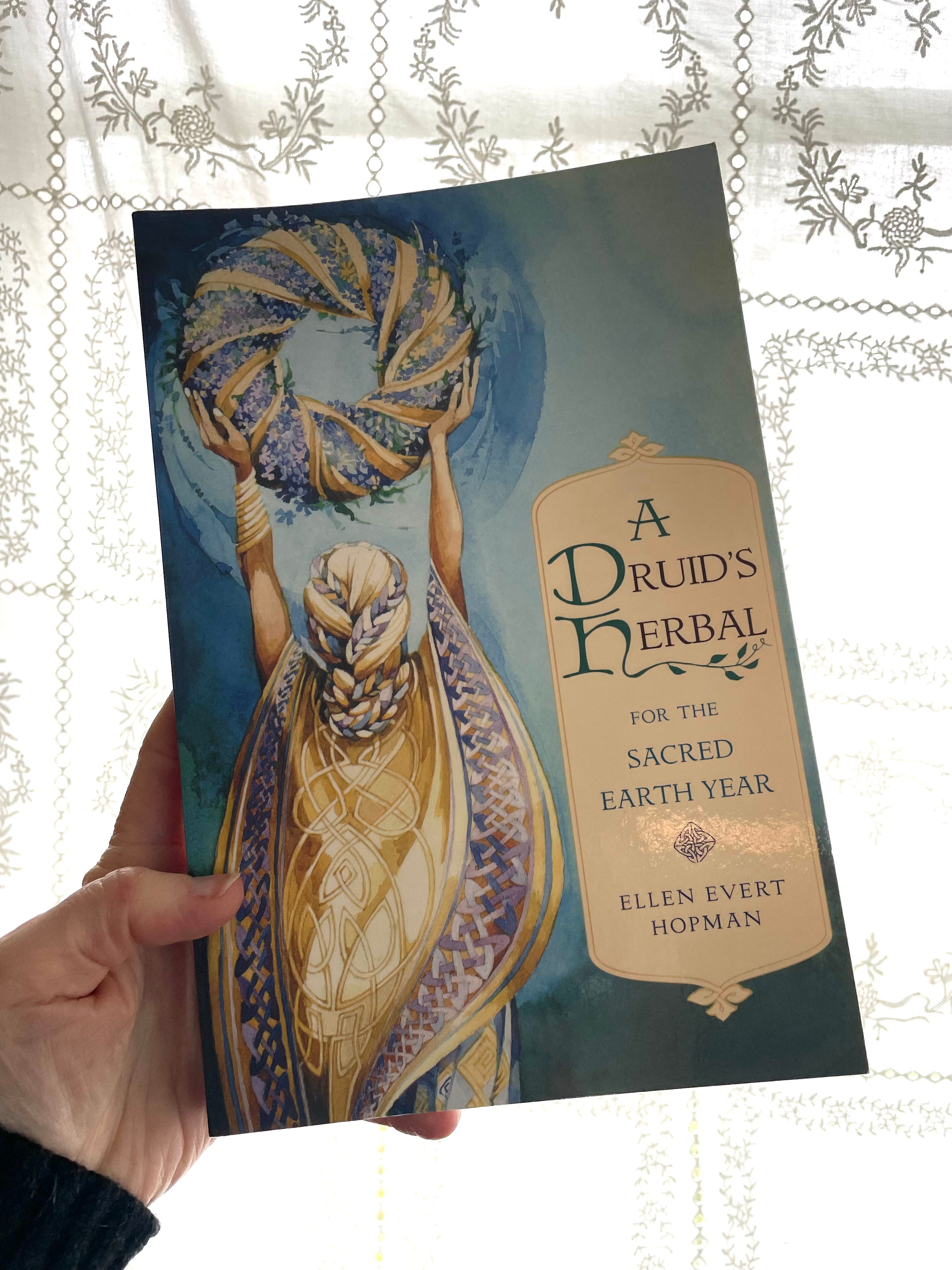
Much of my ancestral reclamation process has been a study of Celtic lore, spirituality, and healing practices. I have many resources and reference books on this topic (which I will likely share more of!), but one that I pull from regularly as I meditate on the seasonal rites is: A Druid’s Herbal for the Sacred Earth Year by Ellen Evert Hopman. This book offers suggestions for weaving herbs into one’s magical practice of honoring the changing seasons, and is deeply rooted in Celtic Druidic tradition.
At the crest of Imbolc, where I live in Northern California, I spied the first cherry blossoms budding on bare branches. After the 1st of February (Imbolc) I have delighted in a cascade of plum blossoms, fluorescent quince flowers, and the re-emergence of buckeye leaves, popping up like chartreuse flames. When we notice what the Earth speaks at these ancestral festivals of the turning wheel, we begin to weave ourselves into the awakening process, begin to speak the silent language of the Earth.
“The cycles of the ritual year remind us that like the plants that lie fallow in winter to reappear in spring, no psychological or material state persists, and we who are life, which is motion, have the continual option of rebirth before us.” - Hopman
For each festival of the year, with special focus on the Celtic traditions, Hopman shares herbs and lore, offering both the herbal uses and magical uses of the plants. For Imbolc she suggests Angelica, Bay, Basil, Blackberry, Coltsfoot, Heather, Iris, Myrrh, Tansy, and Violets. Coincidentally, I started taking Iris flower essence this month. Cultivating the creative stirrings within me.
MY OCCULT ARCHIVE ~ will be an ongoing series! A space to explore the magical texts that have inspired me, and a love letter to the magic that books unlock on and off the page.
Tell me, have you read any of these titles? What magic have these books inspired for you?
Contact me for magical mentorship and 1-1 intuitive divination:
I too am deep in the underworld (12th house transits perhaps?) and I need books to keep myself focused there. Thanks for this.
The erotic poem is an all-timer for sure. What elegant euphemisms