
My tarot initiation
celebrating 10 years of Wanderer's Tarot!

Greetings from the hedge!
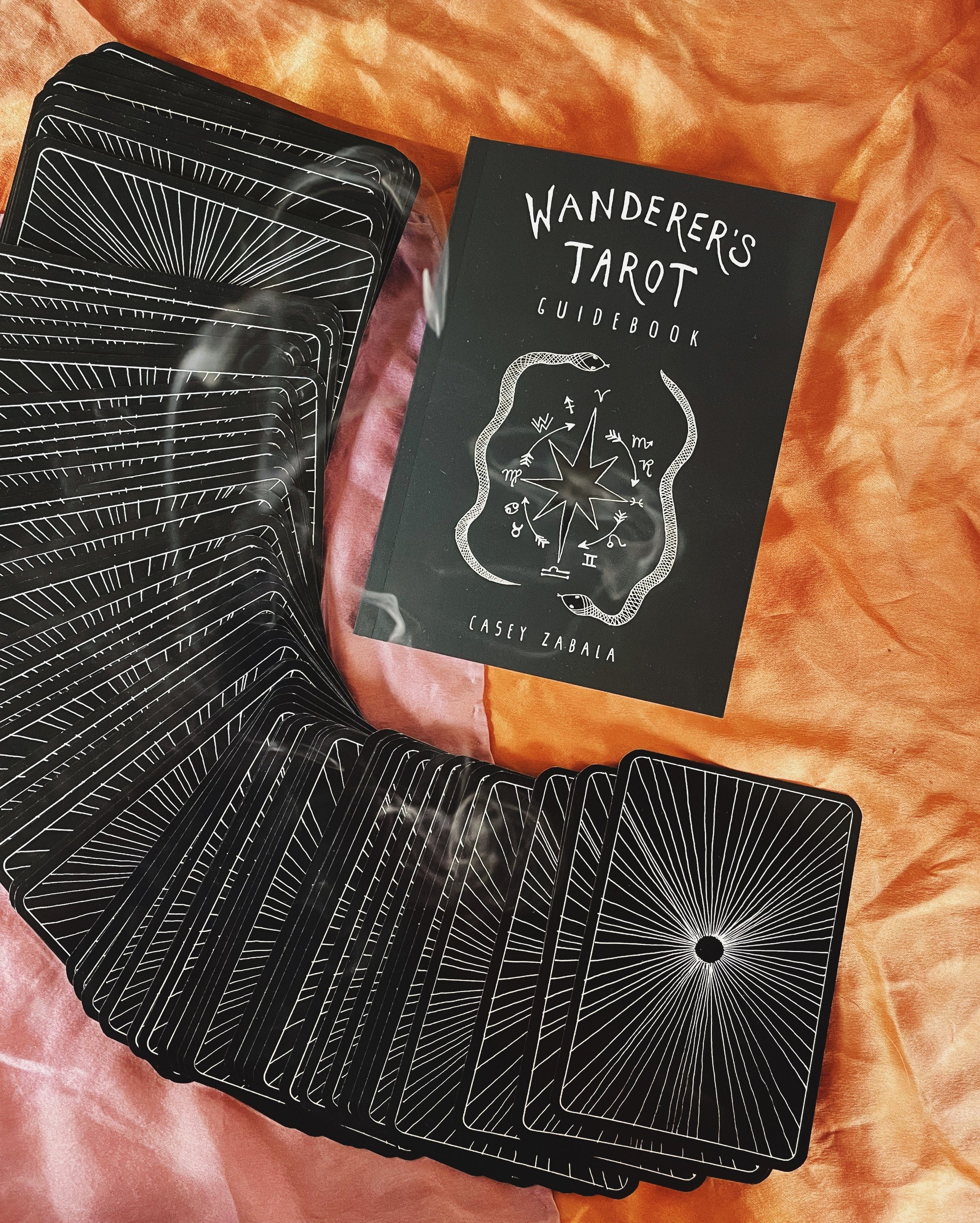
I’m celebrating 10 years (!) since the publication of Wanderer’s Tarot, a feminist tarot deck for modern witches. I am in awe of the experiences the deck has brought me; the friends I have made, the folks I am honored to support through magical counsel, and the community of collaborators I am blessed to orbit with. Wanderer’s Tarot initiated my life as a public witch, supported my work as an intuitive, guided me through the pain of the witch-wound, sparked pure magic, and creative growth.
From a young age I felt unseen presences, had revelatory dreams, and was identified as an “old soul,” but it was my first encounter with the Tarot that initiated my life guided by spirit. It would be safe to say that tarot is my spiritual center, and divination is my way of life.
After 10 years of Wanderer’s Tarot out in the world, its magic being worked by countless witches in their own practices, a new evolution of my work and practice are taking shape. Here’s to continuing to nurture our spiritual roots, expand into our soul’s calling, and live by the cosmic truth of our interconnection. Tarot is magic, and it activates magic in our world.
Below is a revised essay from the Wanderer’s Tarot Guidebook on my tarot initiation, the esoteric lineage of the deck, and a prayer for this work to continue to support those who go with the goddess.
On my twelfth birthday I was introduced to the oracle. The sun was sinking behind the aspen trees, creating a lacy August light, pooling over the table where we sat. We were by the river that afternoon, my mother, her friend and I, watching the gnats frenzy above the rivulets of cool dark matter, a powerful presence anchoring us. I unwrapped the package set before me, and joy tingled through me as I realized what I had been gifted. A deck of cards, speckled with stars, with vibrant, illuminating images. In the waning summer light we all had our cards read and I still remember what those cards shared with us. After that evening my life was permanently altered. Something about how the cards shuffled in my hands, and how they spoke with such clarity and grace enamored me, and I initiated my divinatory practice then and there.
My first tarot reading was a genuine moment of spiritual awakening. After many years of struggling through long Sunday services and awkwardly grappling with the mythos of my Catholic upbringing, the experience of communicating directly with what felt like a divine force fundamentally altered the way I would make meaning in this world. My communion with tarot felt divine because it witnessed parts of myself that I had kept secret, tenderly hidden away from the world. Despite the walls I had built up around myself, the spirit of the Tarot saw right through me. No longer did I feel alienated and alone in a world that had no inherent meaning. Tarot initiated a connection to the sacredness in my own existence, to the life force in the falsely inanimate, and in the potential to follow a path which might lead to some grain of truth. The fluidity of my first encounter with divination compounded my understanding that Tarot cards offer revelation, particularly for those who have a basic trust in their intuition. Over time, I learned that Tarot can become a potent ally in honoring and empowering our innate intuitive abilities. Beyond this powerful potential, the Tarot itself holds keys for unlocking an understanding of the esoteric undercurrents of humanity, and potentially consciousness itself. The energies I continue to encounter within the tarot, and the truths it connects us with, are of an esoteric lineage, one that is important to encounter and honor in its full complexity if one is to sincerely work with Tarot.
The mystical teachings of the Tarot are products of a complex network of occult philosophies. In order to fully grasp Tarot’s teachings, as well as its spiritual capacity, the earnest seeker must endeavor to understand the occult basics. While there is no definitive origin for Tarot, there is a rich narrative of occult philosophies that participated in its inception and consequential development throughout the ages. Countless secret societies, mystical orders, witches and ceremonial magicians have shaped and protected the magical art of the tarot, each leaving their mark on the tradition of decks, correspondences, and spiritual energies which comprise the 78 card pack. Without a basic understanding of what these cultural currents and thinkers believed and practiced, we will understand very little about the spiritual essence of our beloved Tarot decks.
To begin to understand Tarot’s spiritual essence, one must peer into the culture from which it was formulated. The first tarocchi cards were crafted in Italy in the 14th century. These decks were commissioned by wealthy aristocratic families. The ornate quality of these decks can be likened to devotional images, or prayer cards, and were perhaps used not solely as a deck of cards, or for divination purposes, but for purposes of meditation, prayer, and magic. Unlike today, worldviews of 14th-15th century Italy were steeped in magical tradition. During the time, Hermeticism experienced a resurgence, largely due to the translation of the Corpus Hermeticum by Marsilio Ficino commissioned by the Cosimo de’Medici in 1463. At the time, Astrology was still a respected science, and the use of images to capture and enhance magical essences was widely practiced. It was in this moment in time—when magical worldviews still persisted and when images and symbols held powerful grips over the human psyche and interfaced meaningfully with the natural world—that Tarot cards emerged.
If we accept the basic magical worldview of the Renaissance, we can see how Tarot was born within a lineage of image-magic. This means that each archetype and card have the potential to house spirits. The Strength card with its gentle yet formidable lion tamer not only represents the power of the will when married with spirit, it actually can invoke the daimon who enchants wild beasts and embodies effortless grace. Tarot not only empowers our intuitive faculties, it weaves us back into a web of spirit communion and connection, with the archetypes illuminated on each card. When communing with spirits of any sort, it is wise to have a clear understanding of their character, intentions, and their story. To work with the spirits of the tarot, we have to gain a clearer understanding of the lineage of these spiritual identities, Hermeticism.
To work with the tarot is to enter into conversation with the Hermetic arts, whether one is aware of it or not. The Hermetic philosophical framework was born of the mysterious figure and works of Hermes Trismegistus, and the body of writings known as the Corpus Hermeticum. Hermes Trismegistus, also known as Hermes the Thrice Great, is at once a magical synthesis of the Greek God Hermes and the Egyptian God Thoth, and potentially a historical scholar, or a lineage of many scholars who published under the pseudonym. One pathway to a deeper understanding of the Hermetic lineage is to read portions of the Corpus Hermeticum, and to work with the constellation of deity and archetype that give shape to Hermes Trismegistus. The Corpus Hermeticum inspired countless esotericists and occultists to cultivate magical sciences and practices, one such art being the tarot.
The ultimate goal of the Hermetic path is to achieve gnosis. Gnosis is a direct embodied experience of wisdom, the kind of wisdom that floods our consciousness with novel awareness and facilitates a lived experience of the interconnectedness of all things. The project of attaining gnosis is what sets esotericists apart from other spiritual paths. The pathway to gnosis is littered with hidden treasures, encoded secrets, and signposts in plainsite. An esotericist is a collector of symbols, associations, and ultimately meaning. As we walk the Hermetic path of gnosis we gain greater awareness of the spiritual essence and meaning of all elements of life; for example, Venus’ descent into the underworld teaches us about our own interior shadowlands, or the caw of a crow heralds the call to justice in some matter. Hermeticism’s cosmological framework holds that all elements of life are inherently meaningful. One of the more famous Hermetic axioms attributed to Hermes Trismegistus, “as above, so below,” refers to the macrocosm mirroring the microcosm, and likewise, intimating that all levels of reality are intricately related and correspond to one another. Meaning, that the world we exist within is a reflection of our interior psyche, and likewise, our interior psyche projects out and shapes the external world we experience. Or as Jungian analyst and tarot reader Richard Roberts frames it from a psychological viewpoint, “as within, so without.’’ When we approach Tarot from this Hermetic framework, we have more grounding in how the deck wishes to operate. Through interacting with these archetypes, we are being given clues as to how to access gnosis, awakening, inner knowing. Each Tarot symbol is a mirror through which deeper understanding of oneself and one’s world can be gleaned. In the Tarot as in Hermeticism, through the study of nature, humankind studies the psyche.
Hermeticism is one fragment of the philosophical make-up of the tarot, which itself is an occult library of sorts. Occult symbolism is an amalgamation of many different traditions; Numerology, Cabalistic cosmology, Alchemy, Tantra, Astrology, the teachings of Pythagoras, the mystery schools of Ancient Greece, and others. Yet, Tarot’s symbolism is often seen as a clear summation of Hermeticism by scholars. P.D. Ouspensky, acclaimed Russian esotericist, explains this connection further: “For it represents, as, indeed, many commentators of the Tarot think, a summary of the Hermetic Sciences - the Kabala, Alchemy, Astrology, Magic, with their different divisions. All these sciences, attributed to Hermes Trismegistus, really represent one system of a very broad and deep psychological investigation of the nature of man in his relation to the world of noumena (God, the world of Spirit) and to the world of phenomena (the visible, physical world).” At the heart of the many complex pathways of Occult philosophies, there is an invitation to live in an enchanted world, one that speaks, listens, and participates in our life paths. It is similar for the modern practicing witch; we experience the world as animated, full of soul and spirits to connect and commune with. Bringing a magical approach to our Tarot practice allows us space to connect with the spiritual allies and teachers indwelling the Tarot itself.
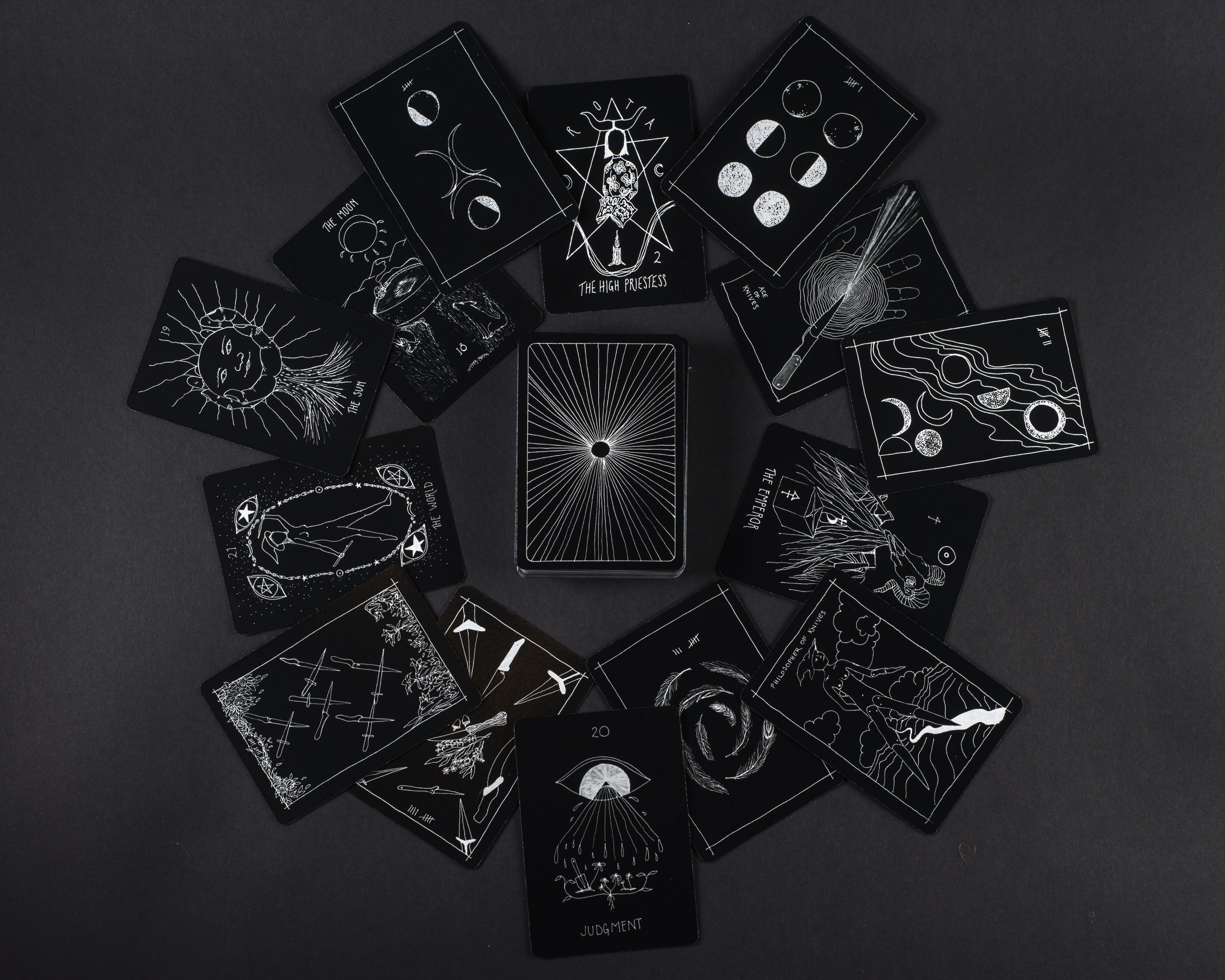
When working consciously with Tarot, we must accept that we are invoking a host of spiritual allies and energies; the more aware of these spirit personalities we become, the more able we will be to receive and integrate their wisdom. The realm of occult studies has not, until recent history, been cautious about cultural appropriation or cultural appreciation. The cannon of occult philosophy includes a vast syncretism of many diverse cultural lineages and wisdom practices. It is our responsibility as modern practitioners to be aware of the multidimensional quality of the tarot pack, and all the energies, personalities, and cultures who have contributed to its long winding history. We must be discerning about what spirits and lineages we choose to work with, to integrate into our practices, and to research with reverence. It is the role of the modern witch to be clear and confident about the historical and energetic frameworks of the tools we use to channel our magic. When we understand the history and context of our tools and practices, our magic grows stronger and more authentically aligned with our souls.
Fifteen years after my first encounter with Tarot, I endeavored to create my own deck—the deck that would become Wanderer’s Tarot. My first task was to make contact with the spirits and energies that would make up this mysterious creation, and culminate through me under the guidance of unseen forces. In order to create a Tarot deck that spoke to my witchcraft, and my evolving feminism, the guiding invocation for the project was to the Goddess, in their many multidimensional gender non-conforming forms. For me, the Goddess is one who inspires, who destroys and creates, who cultivates peace and creates chaos. Just as the Tarot illuminates a rich spectrum of lessons we have the capacity to experience throughout our human incarnations, the Goddess teaches us to find wisdom in all of life’s kin, relationships, opportunities, and challenges. By invoking the Goddess to hold space for this work, I drew a sacred boundary around how the Wanderer’s Tarot expresses its magic. Each card was drawn within a ritual framework to allow space for the spirits who inhabit each card to show up, to bless the work, and to direct the symbolic meaning.
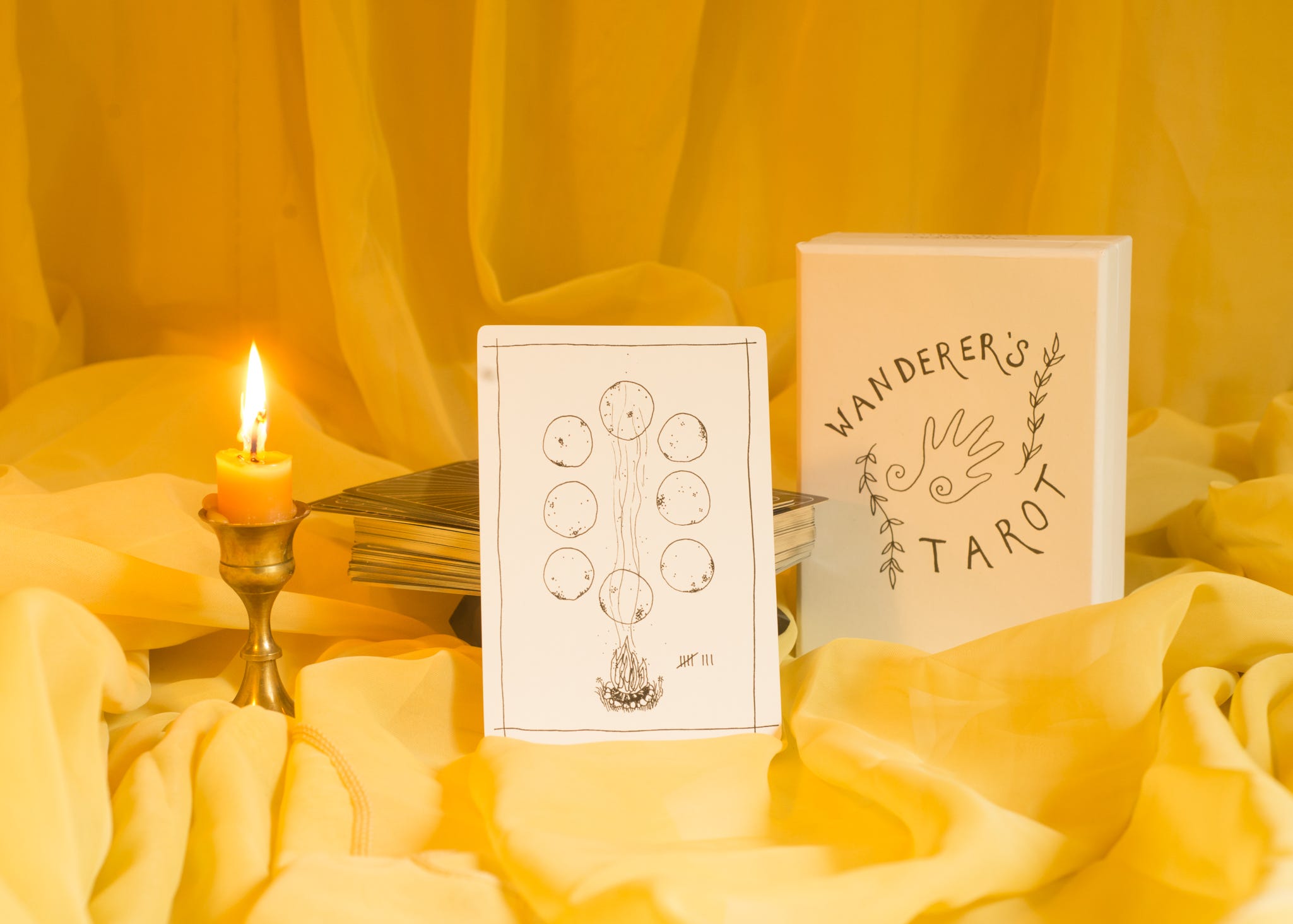
It is my sincere hope that Wanderer’s Tarot provides a pathway to connecting with the Goddess throughout and within, as well as inspires all who encounter its magic to tune into femme wisdom ways. These femme wisdom ways include our intuition, our emotions, our sense of kinship. Humanity finds itself grappling with the dire need for a collective psychic shift, a shift away from patriarchal dominance and towards a re-enchantment of our world. Through the wisdom of the heart (the suit of cups), the mastery of the mind (the suit of swords), a rekindling of magic (the suit of wands), and an ensouled shift towards relating with our Earth (the suit of pentacles) we might have a fighting chance at sustainable transformation. Tarot is not only a tool for self-actualization; it expresses our fundamental interconnectedness. Through tarot we reconnect with our basic need to co-exist within a meaningful universe. The Tarot offers a key through its symbolism, a key to rediscovering human’s place in the interconnected web of life.
May we find hope in the glimpse of a shooting star, feel exalted by the rising of the full moon, and whisper thanks for the gift of a wild turkey feather. May our tarot decks be tools that expand our capacity to imagine new worlds, and support us in cultivating cultures which center care.
Learn more about Casey’s work, and book your 1-1 intuitive sessions with her here.
Congrats on this milestone, Casey! Love reading the genesis of your practice and Wanderer's Tarot. It's become one of my favorites! 🖤